New England Steam
Amazing and eclectic steam from the 1930s handled the unique terrain and transportation issues of New England.
New England Ingenuity 2-Set
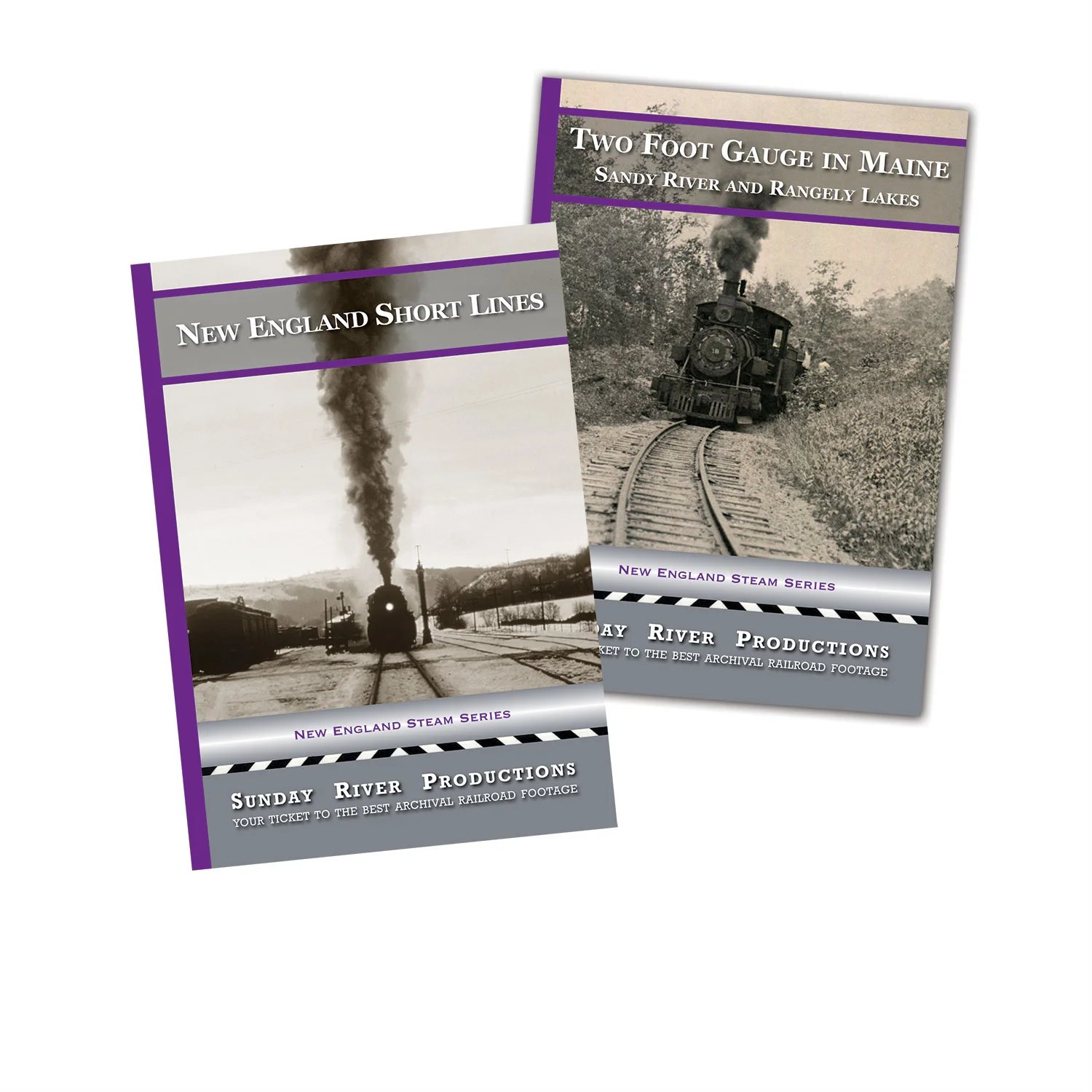


New England Ingenuity 2-Set
Two great examples of New England steam in the 1930s. Fascinating!
Two-Foot Gauge in Maine: Sandy River and Rangely Lakes
New England Short Lines
Full description and video preview below
Two-Foot Gauge in Maine: Sandy River and Rangely Lakes
The film is split between the Sandy River and Rangely Lakes and the Bridgton and Harrison, with a four minute segment in the middle on the Monson and the Wiscasset, Waterville and Farmington. This is the only comprehensive record anywhere of these legendary two foot lines actually running. The little engines race through the wildflowers of summer and slug it out with the drifts of Maine winter. Featuring freight and passenger trains—plus the unusual rail buses—you ride the cabs, cabooses and flat cars, put your shoulder to the turntable and actually pull the throttle. Photographed by Albert G. Hale. Additional footage from L. Peter Cornwall and the collection of John Tolley. Sound is of the actual engines themselves recorded by Sunday River. Black & white, 31 minutes.
New England Short Lines
The vibrancy of these short lines give us a picture of life in New England after the Great Depression. These small lines, some only 7 or 8 miles long, were often built to serve a specific commodity such as milk, ice, limestone, iron ore or granite, and their survival was dependent on both Yankee ingenuity and the market for these items. In the 1930s these railroads operated independently, beyond the control of the major rail systems, and did business much as they had done when they were first built in the mid-1800s. Photographed by Albert Hale and L. Peter Cornwall. Sound by Preston S. Johnson and Sunday River.
The lines appear in order on the DVD:
The Belfast and Moosehead Lake
The Knox
The Lake Champlain & Moriah
The Claremont
The Montpelier & Wells River
The Barre
The Saint Johnsbury & Lake Champlain
The Suncook Valley
Black & White, 38 minutes